
How Ball Bearings Reduce Friction: Working Principle and Engineering Benefits

11 NOVEMBER 2026

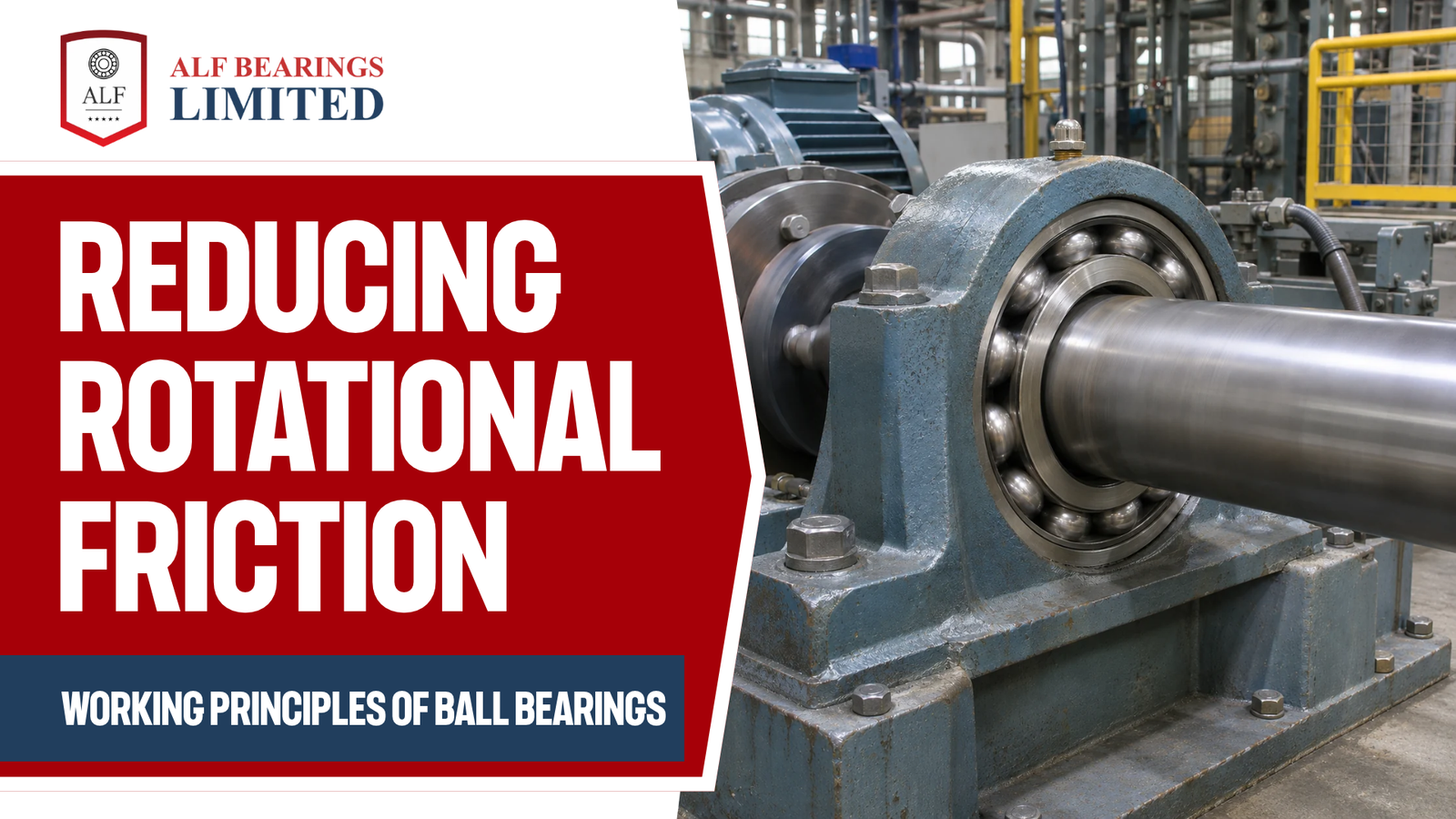
A rotating shaft loses energy when friction resists its movement. In electric motors, wheels, pumps, and industrial machinery, this resistance can increase heat, wear, and power consumption. The bearing working principle involves allowing balls to roll between two raceways rather than depending on direct sliding contact, helping reduce ball bearing friction. 

Deep-groove ball bearings are widely used in mechanical equipment because they support radial loads and can also accommodate axial loads under suitable conditions. Their friction performance depends on load, speed, lubrication, seals, and bearing construction.

What Happens Inside a Ball Bearing?

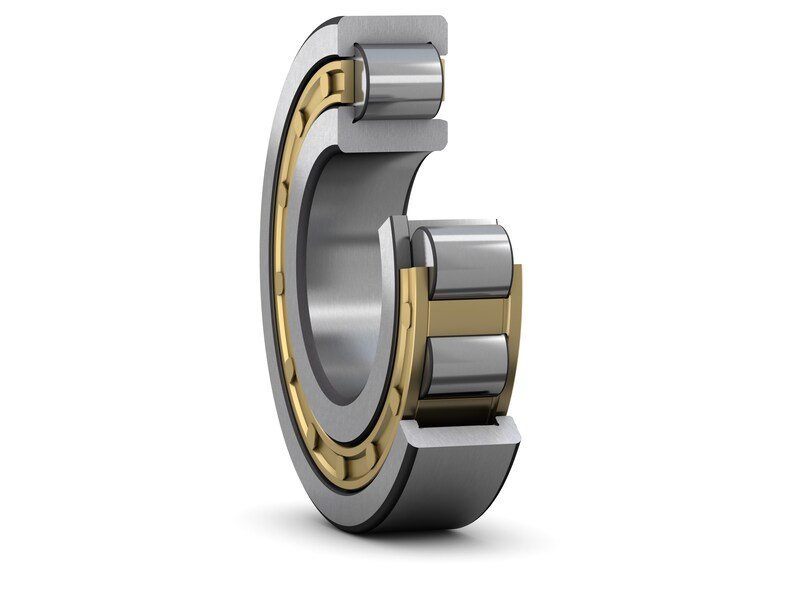
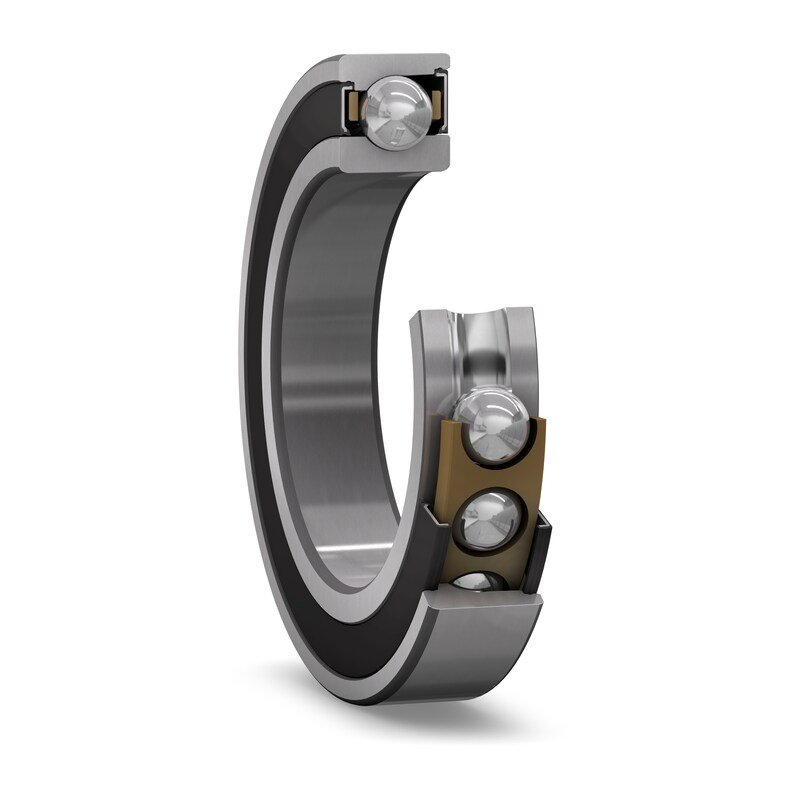
A ball bearing has four main components- an inner ring, an outer ring, balls, and a cage. The inner ring generally rotates with the shaft, while the outer ring is fitted into the housing. As the shaft turns, the balls roll along the grooves, known as raceways, and transfer loads between the rings. This bearing working principle helps maintain smooth shaft rotation.

This arrangement reduces the sliding contact found in a plain bearing, supporting friction reduction during operation. The cage keeps the balls separated, helping prevent them from crowding together and rubbing against one another.

The balls make relatively small contact areas with the raceways. Under load, these contact areas deform into small elliptical regions. This design supports the ball bearing function of carrying loads while maintaining rolling motion, although the small contact area also limits its load capacity compared with a similarly sized roller bearing.

Why Rolling Motion Reduces Friction

Think of moving a heavy object on wheels instead of dragging it across the floor. The wheels make movement easier because they replace much of the sliding resistance with rolling resistance. Ball bearings use the same mechanical principle.

Rolling friction is generally lower than sliding friction under comparable conditions. This helps reduce the torque required to rotate a shaft and limits energy lost as heat.

However, a ball bearing does not eliminate friction. Some resistance comes from the deformation of balls and raceways, lubricant movement, and sliding at certain internal contacts. Seals and cage interactions can also contribute. These factors explain why two ball bearings of similar size may have different friction levels.

Four Factors That Affect Ball Bearing Friction

The rolling elements provide the basic friction-reduction mechanism, but several other factors determine how the bearing performs in service.

1. Lubrication

Grease or oil helps separate the balls from the raceways, reducing wear and protecting the contact surfaces. Too little lubricant can damage the surfaces, while excess grease may increase resistance and operating temperature, particularly at high speeds.

2. Bearing load

Higher loads increase contact pressure and elastic deformation between the balls and raceways. This can increase friction and affect bearing life if the load exceeds the design limits.

3. Rotational speed

At higher speeds, lubricant movement and churning can contribute more to friction. The grease type, oil viscosity, cage design, and seal arrangement must suit the intended speed.

4. Internal clearance and alignment

Incorrect clearance, excessive preload, or misalignment can increase contact forces and friction. Proper mounting and the specified internal clearance help the bearing operate as intended.

How Ball Bearings Help Machinery Operate Efficiently

The benefits are visible across different types of equipment.

Electric motors – Low-friction rotation helps reduce mechanical power losses.

Automotive wheels – Bearings support vehicle loads while allowing the wheels to rotate.

Pumps and fans – Suitable bearings support rotating shafts during continuous operation.

Industrial machinery – Reduced friction can help limit heat generation and wear during repeated movement.

The actual energy savings depend on the complete machine, operating conditions, and bearing selection. A bearing alone cannot guarantee higher efficiency if the equipment has poor alignment, unsuitable lubrication, or other sources of mechanical resistance.

Ball Bearings vs. Plain Bearings

The main difference lies in how the moving surfaces interact. A ball bearing uses rolling elements between raceways, whereas a plain bearing supports a shaft through sliding contact.

Ball bearings generally offer low starting and running friction, making friction reduction one of their main benefits in applications requiring rotational movement. Plain bearings can be preferable in some heavily loaded, compact, or oscillating applications, particularly when designed to operate with a suitable lubricating film. The better option depends on load, speed, space, maintenance, and operating conditions.

Wrapping it Up

Ball bearings reduce friction by using rolling elements to support loads between two raceways. Their ball bearing function also depends on lubrication, clearance, load, and installation. Selecting the correct bearing for the application and maintaining it according to the specified conditions helps control heat, reduce wear, and limit unnecessary energy loss.

FAQs

1. How do ball bearings reduce friction?

They allow balls to roll between the inner and outer raceways, reducing much of the direct sliding contact between moving parts.

2. What is rolling friction?

Rolling friction is the resistance that occurs when an object rolls over a surface. It is generally lower than sliding friction under comparable conditions.

3. Does grease reduce ball bearing friction?

Suitable grease helps maintain a protective lubricating film and limit wear. The wrong type or excessive quantity can increase friction.

4. Can ball bearings eliminate friction completely?

No. Contact deformation, lubricant resistance, seals, and cage interaction still produce friction.

5. What causes high friction in ball bearings?

Poor lubrication, excessive loads, incorrect clearance, contamination, misalignment, and unsuitable operating speeds can increase friction.
Deep Groove vs Angular Contact Bearings: Which to Choose? 

30 SEPTEMBER 2026

Choosing the right bearing is not just about matching the bore size. You also need to consider the load on the shaft, operating speed, accuracy requirements, and the overall design of the machine.

Understanding deep groove vs angular contact bearings can make this selection easier. Both are types of ball bearings, but their internal designs are different. Because of this, they handle radial and axial loads in different ways.

In this bearing selection guide, we explain how each bearing works, where it is commonly used, and the key factors to consider when choosing the right option for your application.

Deep Groove vs Angular Contact Bearings: What Is the Main Difference?

The key difference is the way each bearing transfers load.

A deep groove ball bearing is primarily suited to radial loading while also accommodating a limited amount of thrust from either side. An angular contact ball bearing is designed for situations where radial and axial forces need to be carried together, especially when the axial component is more significant.

Here is a quick comparison:

FactorDeep Groove Ball BearingAngular Contact Ball Bearing
Main purposePrimarily radial loadingCombined loading
Axial loadModerateGreater axial load capability
Thrust directionCan accommodate either directionPrimarily one direction for a single row
Raceway geometrySymmetrical groovesAngled load path
MountingUsually straightforwardArrangement and orientation require more attention
Common useGeneral rotating machineryPrecision and combined load machinery

What Is a Deep Groove Ball Bearing?

A deep groove ball bearing contains balls that travel through matching grooves formed in the inner and outer rings. The geometry provides a large contact area around each ball while allowing smooth rotation.

Its main job is to support forces acting across the shaft. At the same time, the design can accommodate a certain level of force acting along the shaft in either direction.

This combination makes it a practical choice for a wide range of machinery.

Typical uses include:

  • Electric motors
  • Industrial fans
  • Pumps
  • Conveyor systems
  • Gearboxes
  • Automotive assemblies
  • General manufacturing equipment

Another reason for its widespread use is its low friction characteristics. With the correct lubrication and operating conditions, the bearing can perform effectively at high rotational speeds.

How Does an Angular Contact Ball Bearing Work?

An angular contact ball bearing uses a different raceway arrangement. Instead of transferring force primarily across the bearing, its internal geometry creates an angled path between the balls and raceways.

Because of this load path, radial and axial forces can be supported at the same time.

The angle itself also influences bearing behaviour. Designs with larger contact angles generally provide increased capacity for axial force, while other configurations may be chosen when rotational speed is a greater priority.

A single row design mainly accepts axial force from one direction. If a machine produces thrust in both directions, two bearings can be installed in a suitable arrangement.

Angular contact bearings are commonly found in:

  • Machine tool spindles
  • Compressors
  • Precision gearboxes
  • Industrial pumps
  • Robotics equipment
  • High speed machinery

Which Bearing Handles Combined Loads Better?

When an application has to handle significant radial and axial loads at the same time, an angular contact ball bearing is often a suitable choice.

Its angled contact design helps the bearing manage both forces together during operation.

A deep groove ball bearing can also support a combination of radial and axial loads. However, it is usually preferred when the radial load is the main force and the axial load is relatively moderate.

That is why bearing size alone should not decide the selection. The actual load direction and operating requirements of the machine also need to be considered.

What About Speed and Accuracy?

High speed operation alone does not decide which bearing is right for an application. Other operating conditions also need to be considered.

Deep groove ball bearings are commonly used in equipment that runs at higher speeds. Their simple internal design helps reduce friction and allows the bearing to rotate smoothly.

An angular contact ball bearing can be suitable when high speed is combined with the need for better rigidity and precise shaft control. In some applications, these bearings are used with preload to reduce unwanted internal movement.

The actual speed capability of any bearing depends on several factors. These include bearing size, applied load, lubrication, cage design, operating temperature, internal clearance or preload, and correct installation.

Bearing Selection Guide: Which Type Fits Your Application?

A useful bearing selection guide starts with the machine’s operating conditions rather than the bearing catalogue.

A deep groove bearing may be considered when:

  • Most of the load acts radially.
  • Axial forces are relatively moderate.
  • Thrust may occur from either side.
  • Low friction is required.
  • The equipment has a general purpose rotating application.

An angular contact bearing may be considered when:

  • Radial and axial forces act together.
  • Axial loading is more demanding.
  • Shaft positioning needs greater control.
  • Higher rigidity is required.
  • Paired or preloaded installation is needed.

Bearing dimensions are only one part of the decision. Lubrication, temperature, speed, alignment, mounting space, contamination, precision, and expected operating life should also be reviewed.

Final Thoughts

Choosing between deep groove vs angular contact bearings depends on what the bearing needs to handle in actual operation. Deep groove ball bearings work well in many everyday industrial applications where radial loads are higher and axial loads are limited. Angular contact ball bearings are generally used when both radial and axial forces need to be managed together.

ALF Bearings Limited offers bearing solutions for a variety of industrial requirements. Looking at factors such as load, speed, accuracy, lubrication, and working conditions before choosing a bearing can help reduce unnecessary wear and keep machinery running reliably for longer.

FAQs

1. How do deep groove and angular contact bearings handle loads differently?

A deep groove ball bearing works well when most of the force is radial, although it can also carry limited axial force. An angular contact ball bearing has a different raceway design that allows it to deal more effectively with radial and axial forces acting together.

2. What information is needed before choosing a ball bearing?

A proper bearing selection guide should consider load type, load magnitude, shaft speed, operating temperature, lubrication method, available installation space, required precision, and expected service life. These details help determine which bearing design fits the application.

3. When should angular contact ball bearings be considered?

Angular contact bearings are useful when a machine experiences combined loads or requires accurate shaft positioning. They are commonly considered for high speed and precision applications where axial load capacity is also important.

4. What is the purpose of using two angular contact bearings together?

Using two bearings together provides greater flexibility in handling loads. Depending on the mounting arrangement, the pair can manage axial forces acting from opposite directions and can also provide better support and rigidity to the shaft.

5. Why are deep groove bearings widely used in motors?

Their simple design, low friction, and ability to operate efficiently at high rotational speeds make them suitable for many electric motors. They also provide reliable support where radial force is the primary load.


Types of Bearings and Their Uses Explained

14 AUGUST 2026

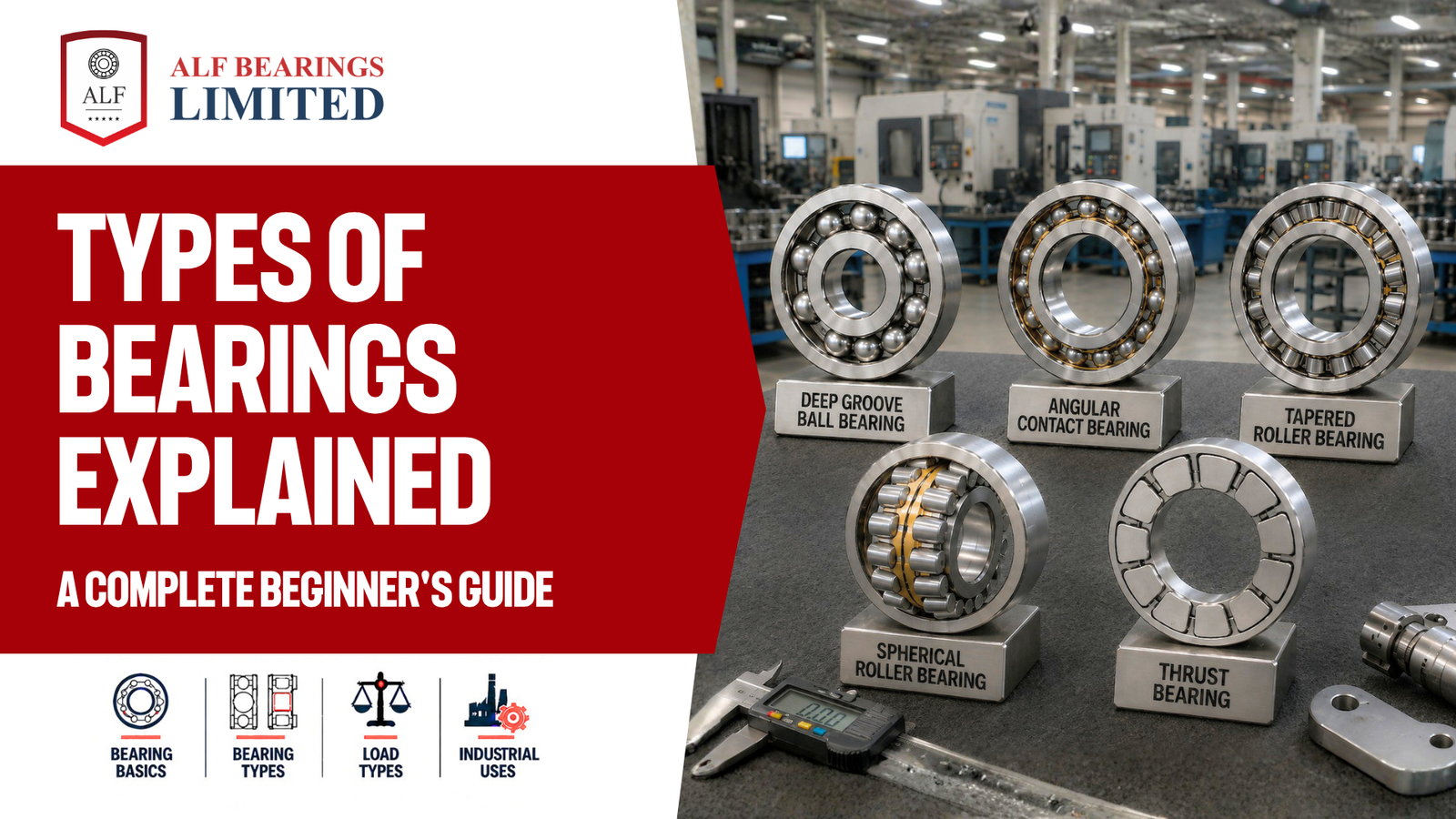
Why isn’t one bearing suitable for every machine? Every machine operates under different loads, speeds, and working conditions, so the same bearing cannot perform equally well in every application. That’s why manufacturers have developed different types of bearings, each designed to handle specific operating requirements.

From electric motors and pumps to conveyors and heavy industrial equipment, choosing the right bearing helps improve performance, reduce wear, and support reliable operation. The different types of bearings are designed for specific applications, making it easier to choose the right option and reduce unnecessary maintenance issues.

Common Types of Bearings and Where They Are Used

Each bearing is designed to handle a particular combination of load, speed, and operating conditions. The following table provides a quick overview of the most common industrial bearing types and their typical applications.

Bearing TypeBest ForCommon Applications
Deep Groove Ball BearingHigh-speed, light to moderate loadsElectric motors, pumps, fans
Angular Contact BearingCombined radial and axial loadsMachine tools, gearboxes
Tapered Roller BearingHeavy radial and axial loadsAutomotive wheel hubs, conveyors
Spherical Roller BearingHeavy loads with shaft misalignmentMining equipment, crushers, paper mills
Thrust BearingAxial loadsCranes, gear systems, rotary tables

Most Common Types of Bearings

1. Deep Groove Ball Bearing

The deep groove ball bearing is one of the most widely used ball bearings because of its simple design and versatility. It operates efficiently at high speeds while handling radial loads and light axial loads.

These bearings are commonly used in electric motors, pumps, fans, washing machines, and compressors. Their low maintenance requirements and long service life make them suitable for many everyday industrial applications.

2. Angular Contact Bearing

An angular contact bearing is designed for applications where both radial and axial loads are present. The contact angle between the balls and raceways allows it to support higher axial forces than standard ball bearings.

These bearings are often found in machine tool spindles, pumps, compressors, and precision equipment where speed and accuracy are important.

3. Tapered Roller Bearing

Unlike ball bearings, a tapered roller bearing uses tapered rollers to distribute loads over a larger contact area. This design allows it to carry heavy radial loads together with significant axial loads.

It is widely used in automotive wheel hubs, agricultural machinery, construction equipment, and conveyor systems that operate under demanding conditions.

4. Spherical Roller Bearing

A spherical roller bearing is built for heavy-duty applications. Its self-aligning design allows it to continue operating even when the shaft is slightly misaligned, making it suitable for harsh working environments.

Mining machinery, vibrating screens, crushers, paper mills, and cement plants commonly use these bearings because they can withstand heavy loads and continuous vibration.

5. Thrust Bearing

A thrust bearing is specifically designed to support axial loads rather than radial loads. It controls movement along the shaft while allowing smooth rotational motion.

These bearings are commonly used in cranes, automotive transmissions, rotary tables, and industrial gear assemblies where axial forces are dominant.

Rolling Bearings vs. Roller Bearings: What’s the Difference?

Many beginners confuse rolling bearings with roller bearings, but they are not the same.

Rolling bearings are a broad category that includes both ball bearings and roller bearings. They reduce friction by placing rolling elements between the inner and outer rings.

Roller bearings are one type of rolling bearing that uses cylindrical, tapered, spherical, or needle-shaped rollers instead of balls. Because rollers provide a larger contact area, they are generally better suited for carrying heavier loads.

This difference makes it easier to compare industrial bearing types and choose the right option for a specific application.

How to Choose the Right Bearing

Selecting a bearing involves more than matching dimensions. Before choosing one, consider-

  • The type of load (radial, axial, or combined)
  • Operating speed
  • Shaft alignment
  • Working environment
  • Temperature
  • Maintenance requirements

For example, a deep groove ball bearing performs well in high-speed applications with moderate loads, while a tapered roller bearing is more suitable for equipment carrying heavier combined loads. Similarly, a spherical roller bearing is often the preferred choice when shaft misalignment is expected.

Choosing the right bearing improves efficiency, reduces wear, and helps equipment operate more reliably.

Wrapping It Up

Every bearing is built for a specific purpose, whether it’s handling high speeds, heavy loads, or shaft misalignment. Choosing from the different types of bearings based on your application’s requirements helps improve performance and keeps equipment running efficiently.

FAQs

What are the most common types of bearings?

The most common types of bearings include deep groove ball bearings, angular contact bearings, tapered roller bearings, spherical roller bearings, and thrust bearings. Each is designed for different load and operating requirements.

What is the difference between ball bearings and roller bearings?

Ball bearings use spherical balls to reduce friction and are generally suitable for high-speed applications. Roller bearings use cylindrical or tapered rollers, providing a larger contact area to handle heavier loads.

Which bearing is best for heavy industrial applications?

A spherical roller bearing is widely used in heavy industrial applications because it supports high loads and can accommodate shaft misalignment. A tapered roller bearing is also a good choice for equipment that experiences heavy radial and axial loads.

Which type of bearing is best for high-speed applications?

A deep-groove ball bearing is one of the best options for high-speed applications because it produces low friction and operates smoothly under light to moderate loads. It is commonly used in electric motors, pumps, fans, and other equipment that requires reliable performance at higher rotational speeds.

How do I choose the right bearing for my application?

Choosing the right bearing depends on factors such as load type, operating speed, shaft alignment, working environment, and maintenance requirements. Comparing the different types of bearings and understanding their applications helps ensure the bearing matches the machine’s operating conditions, improving performance and service life.