
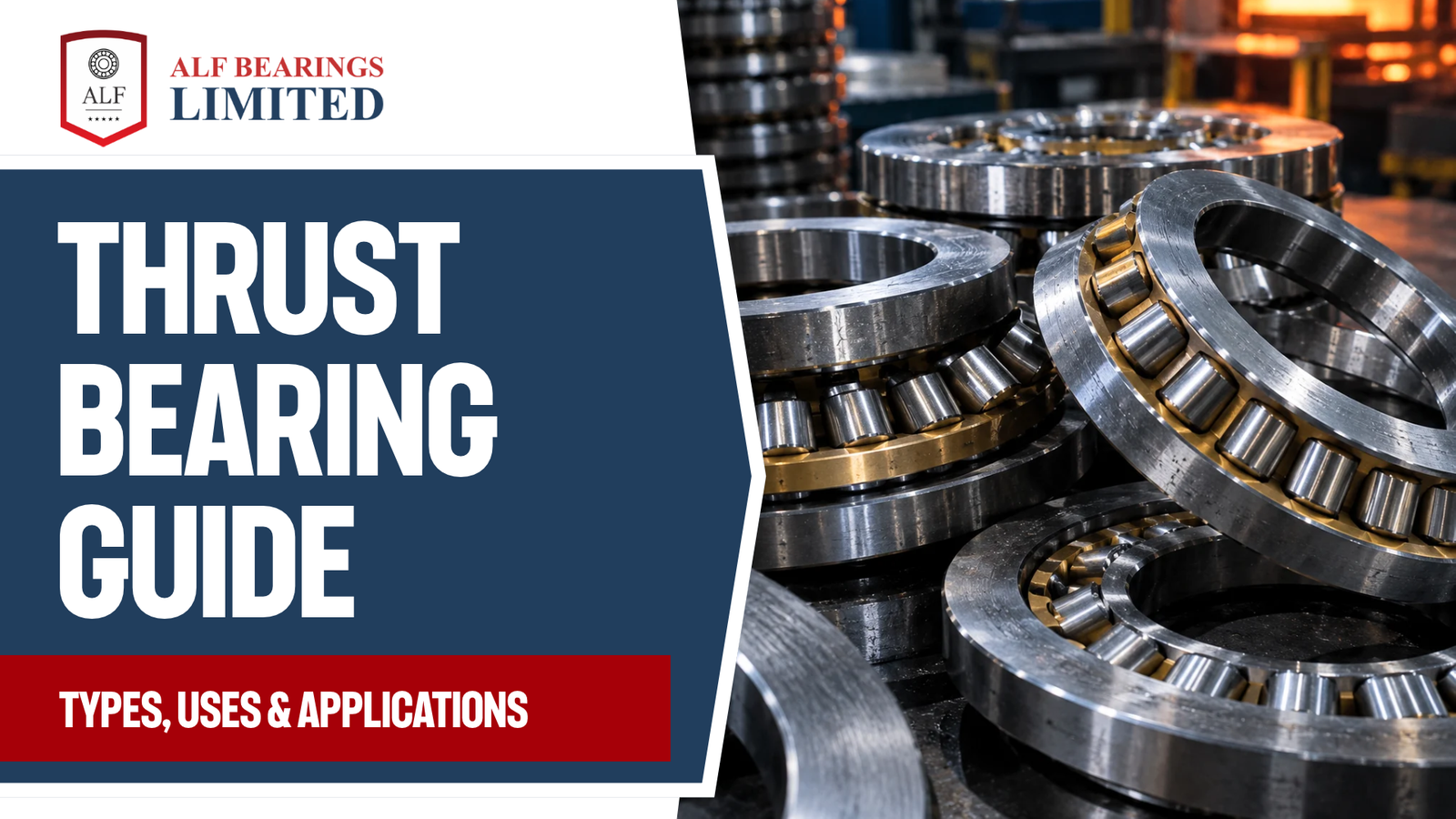
Thrust Bearing | Types, Uses, Applications, and Selection Guide

17 OCTOBER 2026

Have you noticed excessive shaft movement, unusual noise, or premature wear in rotating machinery? These problems can occur when axial loads are not properly supported or bearings are poorly lubricated. Rolling-bearing failure classifications identify lubrication problems, contamination, and material fatigue as possible causes of bearing damage. A thrust bearing supports forces acting parallel to a shaft, while a thrust ball bearing is suitable for applications requiring axial load support with low friction. The right choice depends on the load, operating speed, and working conditions.

What Is a Thrust Bearing?

A thrust bearing supports axial loads that act parallel to a shaft and helps control unwanted movement. It uses balls or rollers between raceways to reduce friction during rotation. For example, in a marine propulsion system, a thrust bearing transfers the propeller’s axial force to the supporting structure. Among the different thrust bearing types, a thrust ball bearing suits lighter axial loads, while thrust roller bearings are available for heavier loads, depending on their design.

What Are the Main Thrust Bearing Types?

Thrust bearings are available in several designs to meet different load and installation requirements. Here thrust bearing types are mentioned.

1. Thrust Ball Bearings

Thrust ball bearings use balls positioned between shaft and housing washers. They are generally suitable for light to moderate axial loads, depending on their design and operating conditions. There are two common configurations.

  • Single-direction thrust ball bearings: Support axial loads in one direction.
  • Double-direction thrust ball bearings: Support axial loads in both directions.

These bearings are used in machine tools, selected automotive mechanisms, and household equipment. They are best suited to applications where radial forces are minimal.

2. Thrust Roller Bearings

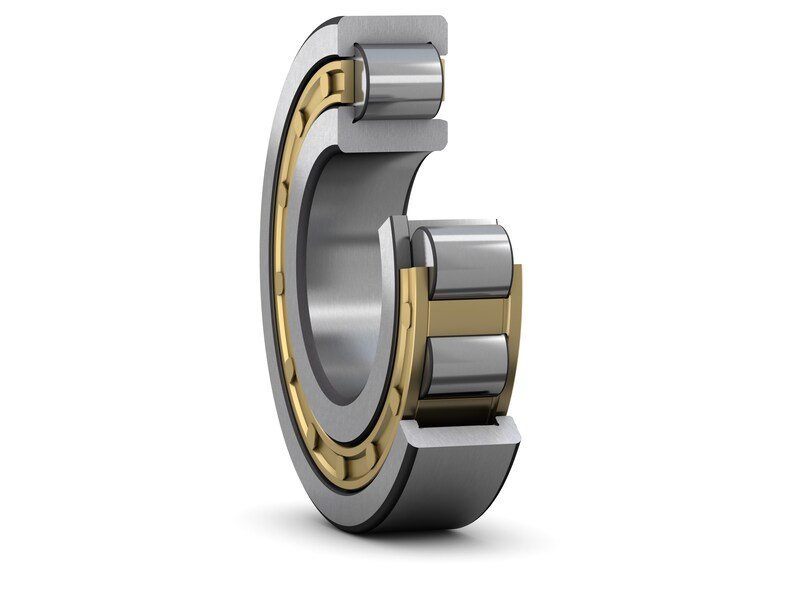
Thrust roller bearings use rollers to support axial loads. Their larger contact area makes several designs suitable for heavier loads than comparable ball-bearing arrangements.

Common Types 

Cylindrical roller thrust bearings: Used in heavy-duty machinery and industrial equipment exposed to substantial axial forces.

Needle thrust bearings: Suitable for compact assemblies where installation space is limited, such as certain transmission mechanisms.

Spherical roller thrust bearings: Handle heavy axial loads and accommodate limited misalignment. Some designs can also support radial loads.

The choice depends on load capacity, operating speed, alignment, lubrication, and available space.

What Are the Common Thrust Bearing Uses?

Thrust bearing uses extend across automotive, manufacturing, marine, and industrial equipment. The bearing helps control axial forces that can otherwise affect shaft positioning and machine operation. Common thrust bearings are used as listed here.

  • Automotive transmissions
  • Industrial pumps
  • Marine propulsion systems
  • Machine tool spindles

Each application has different load and speed requirements, so the bearing must be selected according to the machine’s specifications.

Where Are Tapered Roller Bearings Used?

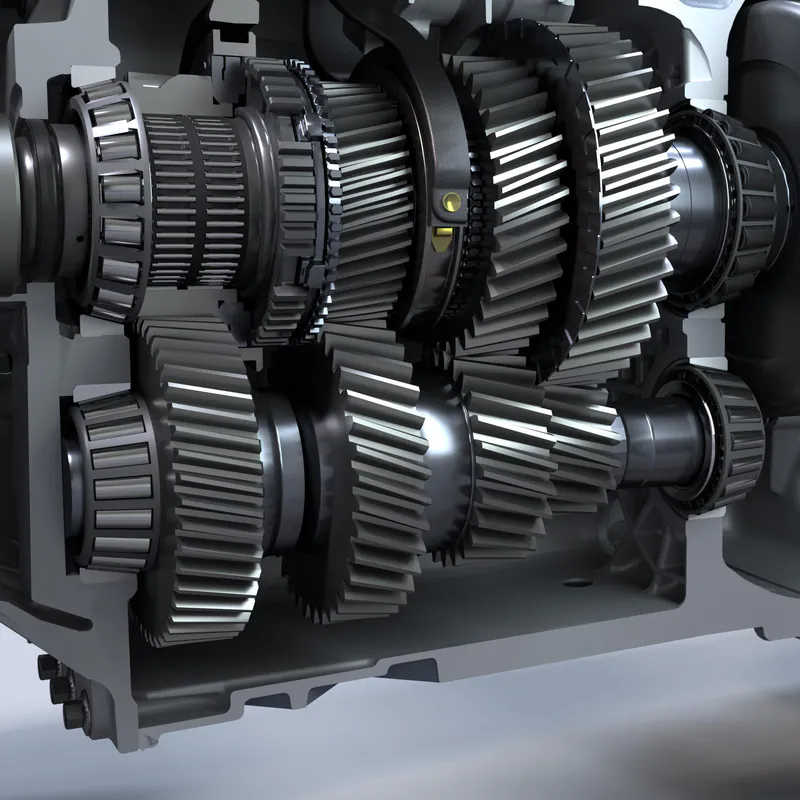
Tapered roller bearings support combined radial and axial loads, making them suitable for machinery exposed to forces from different directions. Common tapered bearing applications include vehicle wheel hubs, gearboxes, differentials, and industrial equipment.

For example, in a car wheel hub, these bearings support vehicle weight while handling cornering forces. Single-row tapered roller bearings are often fitted in pairs to manage axial loads in both directions.

When choosing among tapered bearing manufacturers, compare load ratings, dimensions, material quality, and speed limits to match the bearing to the application.

How to Select the Right Thrust Bearing

Selecting a suitable bearing requires checking the machine’s operating conditions before comparing available models.

  • Calculate the expected load and check the bearing’s dynamic and static load ratings.
  • Confirm that the bearing can operate at the required speed under the specified lubrication conditions.
  • Radial forces: Determine whether the assembly needs separate radial support or a bearing designed for combined loads.
  • Check the bore, outside diameter, width, and mounting arrangement.
  • Choose suitable grease or oil based on speed, temperature, and operating conditions.
  • Consider contamination protection, inspection access, and replacement requirements.

Installation also affects bearing performance. Incorrect mounting, misalignment, excessive loading, and insufficient lubrication can lead to overheating, surface damage, and early failure. Following the manufacturer’s installation instructions helps prevent these problems.

Wrapping It Up

Thrust ball bearings suit applications with lighter axial loads, while thrust roller bearings handle heavier loads depending on their design. For machinery exposed to combined radial and axial forces, tapered roller bearings may be a better choice. Matching the bearing type to the machine’s operating conditions helps prevent premature wear and maintain performance.

FAQ

1. What is the main function of a thrust bearing?

A thrust bearing supports axial loads and controls movement along a rotating shaft.

2. What is a thrust ball bearing used for?

It supports axial loads in applications such as selected machine mechanisms, automotive assemblies, and household equipment.

3. What are the main thrust bearing types?

Common types include thrust ball bearings, cylindrical roller thrust bearings, needle thrust bearings, and spherical roller thrust bearings.

4. Can thrust bearings support radial loads?

Most standard thrust bearings have limited radial load capacity. A separate radial bearing or a suitable combined-load design may be required.

5. What are common tapered bearing applications?

Tapered roller bearings are used in vehicle wheel hubs, differentials, gearboxes, railway equipment, and industrial machinery exposed to combined radial and axial loads.
Deep Groove vs Angular Contact Bearings: Which to Choose? 

30 SEPTEMBER 2026

Choosing the right bearing is not just about matching the bore size. You also need to consider the load on the shaft, operating speed, accuracy requirements, and the overall design of the machine.

Understanding deep groove vs angular contact bearings can make this selection easier. Both are types of ball bearings, but their internal designs are different. Because of this, they handle radial and axial loads in different ways.

In this bearing selection guide, we explain how each bearing works, where it is commonly used, and the key factors to consider when choosing the right option for your application.

Deep Groove vs Angular Contact Bearings: What Is the Main Difference?

The key difference is the way each bearing transfers load.

A deep groove ball bearing is primarily suited to radial loading while also accommodating a limited amount of thrust from either side. An angular contact ball bearing is designed for situations where radial and axial forces need to be carried together, especially when the axial component is more significant.

Here is a quick comparison:

FactorDeep Groove Ball BearingAngular Contact Ball Bearing
Main purposePrimarily radial loadingCombined loading
Axial loadModerateGreater axial load capability
Thrust directionCan accommodate either directionPrimarily one direction for a single row
Raceway geometrySymmetrical groovesAngled load path
MountingUsually straightforwardArrangement and orientation require more attention
Common useGeneral rotating machineryPrecision and combined load machinery

What Is a Deep Groove Ball Bearing?

A deep groove ball bearing contains balls that travel through matching grooves formed in the inner and outer rings. The geometry provides a large contact area around each ball while allowing smooth rotation.

Its main job is to support forces acting across the shaft. At the same time, the design can accommodate a certain level of force acting along the shaft in either direction.

This combination makes it a practical choice for a wide range of machinery.

Typical uses include:

  • Electric motors
  • Industrial fans
  • Pumps
  • Conveyor systems
  • Gearboxes
  • Automotive assemblies
  • General manufacturing equipment

Another reason for its widespread use is its low friction characteristics. With the correct lubrication and operating conditions, the bearing can perform effectively at high rotational speeds.

How Does an Angular Contact Ball Bearing Work?

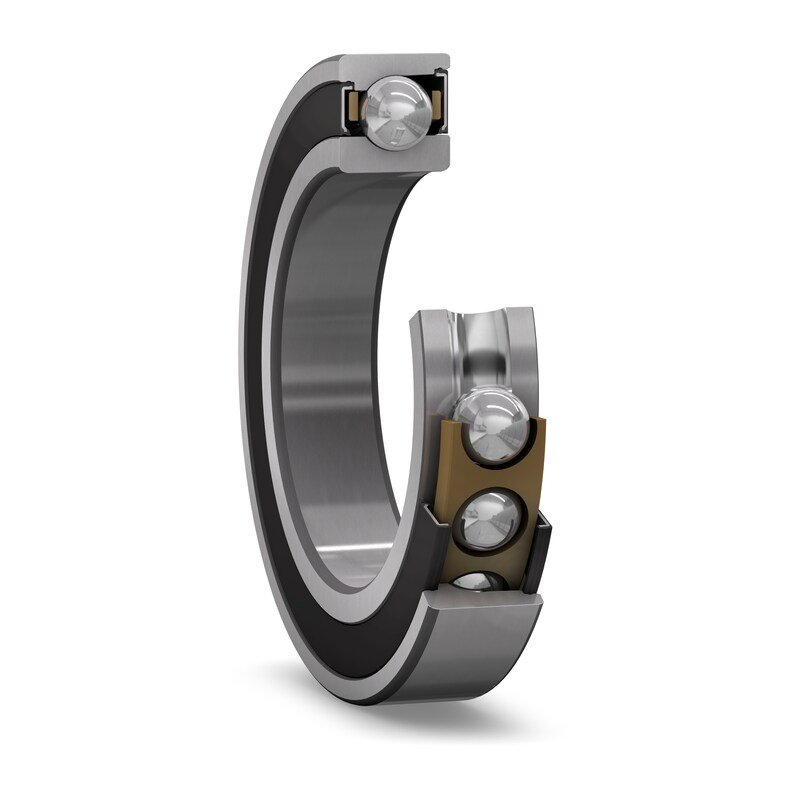
An angular contact ball bearing uses a different raceway arrangement. Instead of transferring force primarily across the bearing, its internal geometry creates an angled path between the balls and raceways.

Because of this load path, radial and axial forces can be supported at the same time.

The angle itself also influences bearing behaviour. Designs with larger contact angles generally provide increased capacity for axial force, while other configurations may be chosen when rotational speed is a greater priority.

A single row design mainly accepts axial force from one direction. If a machine produces thrust in both directions, two bearings can be installed in a suitable arrangement.

Angular contact bearings are commonly found in:

  • Machine tool spindles
  • Compressors
  • Precision gearboxes
  • Industrial pumps
  • Robotics equipment
  • High speed machinery

Which Bearing Handles Combined Loads Better?

When an application has to handle significant radial and axial loads at the same time, an angular contact ball bearing is often a suitable choice.

Its angled contact design helps the bearing manage both forces together during operation.

A deep groove ball bearing can also support a combination of radial and axial loads. However, it is usually preferred when the radial load is the main force and the axial load is relatively moderate.

That is why bearing size alone should not decide the selection. The actual load direction and operating requirements of the machine also need to be considered.

What About Speed and Accuracy?

High speed operation alone does not decide which bearing is right for an application. Other operating conditions also need to be considered.

Deep groove ball bearings are commonly used in equipment that runs at higher speeds. Their simple internal design helps reduce friction and allows the bearing to rotate smoothly.

An angular contact ball bearing can be suitable when high speed is combined with the need for better rigidity and precise shaft control. In some applications, these bearings are used with preload to reduce unwanted internal movement.

The actual speed capability of any bearing depends on several factors. These include bearing size, applied load, lubrication, cage design, operating temperature, internal clearance or preload, and correct installation.

Bearing Selection Guide: Which Type Fits Your Application?

A useful bearing selection guide starts with the machine’s operating conditions rather than the bearing catalogue.

A deep groove bearing may be considered when:

  • Most of the load acts radially.
  • Axial forces are relatively moderate.
  • Thrust may occur from either side.
  • Low friction is required.
  • The equipment has a general purpose rotating application.

An angular contact bearing may be considered when:

  • Radial and axial forces act together.
  • Axial loading is more demanding.
  • Shaft positioning needs greater control.
  • Higher rigidity is required.
  • Paired or preloaded installation is needed.

Bearing dimensions are only one part of the decision. Lubrication, temperature, speed, alignment, mounting space, contamination, precision, and expected operating life should also be reviewed.

Final Thoughts

Choosing between deep groove vs angular contact bearings depends on what the bearing needs to handle in actual operation. Deep groove ball bearings work well in many everyday industrial applications where radial loads are higher and axial loads are limited. Angular contact ball bearings are generally used when both radial and axial forces need to be managed together.

ALF Bearings Limited offers bearing solutions for a variety of industrial requirements. Looking at factors such as load, speed, accuracy, lubrication, and working conditions before choosing a bearing can help reduce unnecessary wear and keep machinery running reliably for longer.

FAQs

1. How do deep groove and angular contact bearings handle loads differently?

A deep groove ball bearing works well when most of the force is radial, although it can also carry limited axial force. An angular contact ball bearing has a different raceway design that allows it to deal more effectively with radial and axial forces acting together.

2. What information is needed before choosing a ball bearing?

A proper bearing selection guide should consider load type, load magnitude, shaft speed, operating temperature, lubrication method, available installation space, required precision, and expected service life. These details help determine which bearing design fits the application.

3. When should angular contact ball bearings be considered?

Angular contact bearings are useful when a machine experiences combined loads or requires accurate shaft positioning. They are commonly considered for high speed and precision applications where axial load capacity is also important.

4. What is the purpose of using two angular contact bearings together?

Using two bearings together provides greater flexibility in handling loads. Depending on the mounting arrangement, the pair can manage axial forces acting from opposite directions and can also provide better support and rigidity to the shaft.

5. Why are deep groove bearings widely used in motors?

Their simple design, low friction, and ability to operate efficiently at high rotational speeds make them suitable for many electric motors. They also provide reliable support where radial force is the primary load.


How to Select the Right Bearing

3 AUGUST 2026

How to choose the right bearing is a question many engineers and maintenance teams face when working with industrial equipment. Bearings may look similar, but they are designed for different loads, speeds, and operating conditions. Selecting a bearing without checking these requirements can lead to frequent replacements, unexpected downtime, and higher maintenance costs. This guide explains the main factors to consider and how to choose a bearing that suits your application.

Factors That Affect Bearing Performance

Choosing the right bearing begins with understanding how the machine will operate. A bearing that performs well in one application may not deliver the same results in another because every machine works under different conditions. During bearing selection, engineers consider the application, load, operating speed, surrounding environment, and expected service life before deciding on a bearing type.

Machine Application

The application gives the first indication of the type of bearing required. A pump, conveyor, electric motor, compressor, and gearbox all create different operating conditions. Some machines run continuously at high speed, while others work under heavy loads or in dusty and wet environments.

For example, bearings used in food processing equipment are often selected for their resistance to moisture and corrosion, while bearings used in mining or construction machinery are chosen for their ability to withstand heavy loads and contamination. Understanding where the bearing will be used helps narrow down the available options and makes choosing bearings more practical.

Load Requirements

Load is one of the biggest factors in bearing selection based on load. Bearings are designed to carry radial loads, axial loads, or a combination of both. Selecting a bearing that does not match the applied load can shorten its operating life and increase maintenance requirements.

Ball bearings are commonly used where moderate loads and higher speeds are involved. Roller bearings provide a larger contact area, allowing them to support heavier radial loads. Tapered roller bearings are widely used in industrial gearboxes, wheel hubs, and similar applications where both radial and axial loads are present. When looking for the best bearing for heavy loads, roller bearings are generally the preferred option.

Operating Conditions

Operating conditions influence bearing performance just as much as load. Temperature, dust, moisture, chemicals, and lubrication all affect how long a bearing will last.

Machines operating at high speeds require bearings that produce less friction and generate less heat. Equipment used outdoors or in harsh industrial environments may need sealed bearings or corrosion-resistant materials to prevent premature wear. Considering these conditions before purchasing a bearing reduces the chances of unexpected failure and unnecessary maintenance.

Matching the Bearing to the Machine

Selecting a bearing becomes easier once the operating conditions are clear. Different bearing designs are developed to meet different performance requirements rather than serving every application in the same way.

Ball Bearings and Their Applications

Ball bearings are widely used in electric motors, pumps, fans, compressors, and other equipment that operates at higher speeds. They offer smooth rotation, low friction, and reliable performance where loads are light to moderate.

Roller Bearings and Their Applications

Roller bearings are commonly installed in conveyors, crushers, paper mills, heavy industrial gearboxes, and construction equipment. Their larger rolling elements distribute the applied load more effectively, making them suitable for demanding applications.

Bearing Selection for Electric Motors

Bearing selection for electric motors requires attention to speed, operating temperature, lubrication, and expected service life. Deep groove ball bearings remain one of the most common choices because they combine low friction with reliable performance during continuous operation. Shaft dimensions, mounting arrangements, and maintenance requirements should also be reviewed before selecting a bearing for an electric motor.

A Few Checks Before Ordering

Many bearing failures are linked to incorrect selection rather than manufacturing defects. Before placing an order, confirm-

  1. The type and direction of the load
  2. Operating speed
  3. Temperature and surrounding environment
  4. Shaft and housing dimensions
  5. Lubrication method
  6. Sealing requirements
  7. Expected operating life

Reviewing these points makes industrial bearing selection more accurate and reduces the chances of early bearing failure.

Wrapping it up

There is no single bearing that works for every machine. A suitable bearing is one that matches the application’s load, operating speed, working environment, and maintenance requirements. Taking the time to evaluate these conditions before ordering can improve machine reliability, reduce downtime, and extend bearing service life.

FAQs

How do I choose the right bearing for an industrial machine?

Consider the machine application, load, operating speed, environment, lubrication, and shaft dimensions before selecting a bearing.

Which bearing is best for heavy loads?

Roller bearings are commonly used for heavy radial loads, while tapered roller bearings are suitable when both radial and axial loads are present.

Which bearing is commonly used in electric motors?

Deep groove ball bearings are widely used in electric motors because they support high-speed operation with low friction and reliable performance.

Can one bearing type be used for all machines?

No. Different machines have different load, speed, and operating requirements. The bearing should match the specific application.

Why is lubrication important for bearings?

Lubrication reduces friction, minimizes wear, and helps extend bearing life by protecting it from heat and contamination.