
Choosing the right bearing is not just about matching the bore size. You also need to consider the load on the shaft, operating speed, accuracy requirements, and the overall design of the machine.
Understanding deep groove vs angular contact bearings can make this selection easier. Both are types of ball bearings, but their internal designs are different. Because of this, they handle radial and axial loads in different ways.
In this bearing selection guide, we explain how each bearing works, where it is commonly used, and the key factors to consider when choosing the right option for your application.
Deep Groove vs Angular Contact Bearings: What Is the Main Difference?
The key difference is the way each bearing transfers load.
A deep groove ball bearing is primarily suited to radial loading while also accommodating a limited amount of thrust from either side. An angular contact ball bearing is designed for situations where radial and axial forces need to be carried together, especially when the axial component is more significant.
Here is a quick comparison:
| Factor | Deep Groove Ball Bearing | Angular Contact Ball Bearing |
| Main purpose | Primarily radial loading | Combined loading |
| Axial load | Moderate | Greater axial load capability |
| Thrust direction | Can accommodate either direction | Primarily one direction for a single row |
| Raceway geometry | Symmetrical grooves | Angled load path |
| Mounting | Usually straightforward | Arrangement and orientation require more attention |
| Common use | General rotating machinery | Precision and combined load machinery |
What Is a Deep Groove Ball Bearing?
A deep groove ball bearing contains balls that travel through matching grooves formed in the inner and outer rings. The geometry provides a large contact area around each ball while allowing smooth rotation.
Its main job is to support forces acting across the shaft. At the same time, the design can accommodate a certain level of force acting along the shaft in either direction.
This combination makes it a practical choice for a wide range of machinery.
Typical uses include:
- Electric motors
- Industrial fans
- Pumps
- Conveyor systems
- Gearboxes
- Automotive assemblies
- General manufacturing equipment
Another reason for its widespread use is its low friction characteristics. With the correct lubrication and operating conditions, the bearing can perform effectively at high rotational speeds.
How Does an Angular Contact Ball Bearing Work?
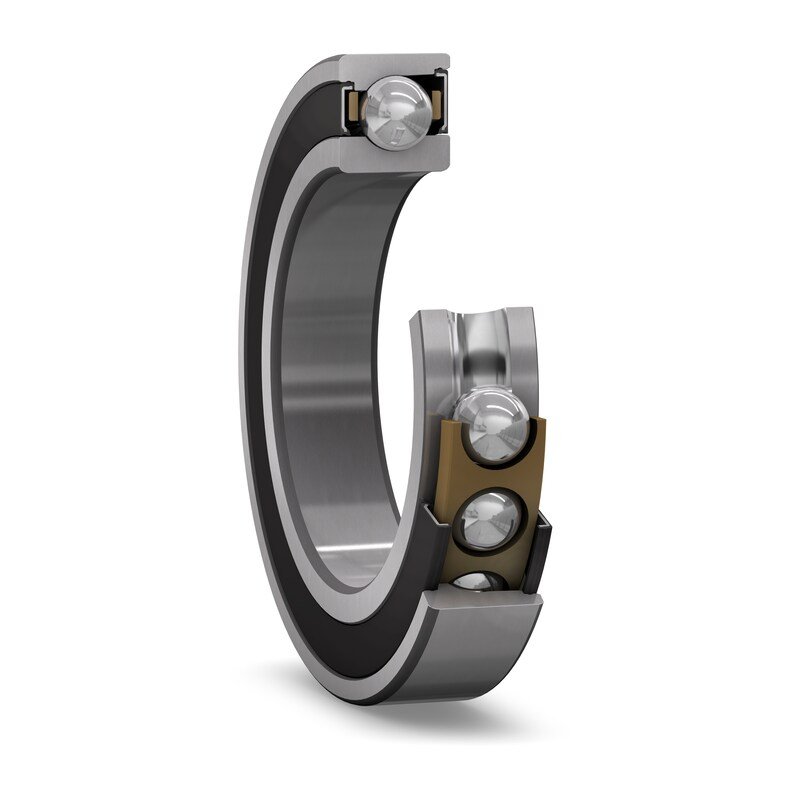
An angular contact ball bearing uses a different raceway arrangement. Instead of transferring force primarily across the bearing, its internal geometry creates an angled path between the balls and raceways.
Because of this load path, radial and axial forces can be supported at the same time.
The angle itself also influences bearing behaviour. Designs with larger contact angles generally provide increased capacity for axial force, while other configurations may be chosen when rotational speed is a greater priority.
A single row design mainly accepts axial force from one direction. If a machine produces thrust in both directions, two bearings can be installed in a suitable arrangement.
Angular contact bearings are commonly found in:
- Machine tool spindles
- Compressors
- Precision gearboxes
- Industrial pumps
- Robotics equipment
- High speed machinery
Which Bearing Handles Combined Loads Better?
When an application has to handle significant radial and axial loads at the same time, an angular contact ball bearing is often a suitable choice.
Its angled contact design helps the bearing manage both forces together during operation.
A deep groove ball bearing can also support a combination of radial and axial loads. However, it is usually preferred when the radial load is the main force and the axial load is relatively moderate.
That is why bearing size alone should not decide the selection. The actual load direction and operating requirements of the machine also need to be considered.
What About Speed and Accuracy?
High speed operation alone does not decide which bearing is right for an application. Other operating conditions also need to be considered.
Deep groove ball bearings are commonly used in equipment that runs at higher speeds. Their simple internal design helps reduce friction and allows the bearing to rotate smoothly.
An angular contact ball bearing can be suitable when high speed is combined with the need for better rigidity and precise shaft control. In some applications, these bearings are used with preload to reduce unwanted internal movement.
The actual speed capability of any bearing depends on several factors. These include bearing size, applied load, lubrication, cage design, operating temperature, internal clearance or preload, and correct installation.
Bearing Selection Guide: Which Type Fits Your Application?
A useful bearing selection guide starts with the machine’s operating conditions rather than the bearing catalogue.
A deep groove bearing may be considered when:
- Most of the load acts radially.
- Axial forces are relatively moderate.
- Thrust may occur from either side.
- Low friction is required.
- The equipment has a general purpose rotating application.
An angular contact bearing may be considered when:
- Radial and axial forces act together.
- Axial loading is more demanding.
- Shaft positioning needs greater control.
- Higher rigidity is required.
- Paired or preloaded installation is needed.
Bearing dimensions are only one part of the decision. Lubrication, temperature, speed, alignment, mounting space, contamination, precision, and expected operating life should also be reviewed.
Final Thoughts
Choosing between deep groove vs angular contact bearings depends on what the bearing needs to handle in actual operation. Deep groove ball bearings work well in many everyday industrial applications where radial loads are higher and axial loads are limited. Angular contact ball bearings are generally used when both radial and axial forces need to be managed together.
ALF Bearings Limited offers bearing solutions for a variety of industrial requirements. Looking at factors such as load, speed, accuracy, lubrication, and working conditions before choosing a bearing can help reduce unnecessary wear and keep machinery running reliably for longer.
FAQs
A deep groove ball bearing works well when most of the force is radial, although it can also carry limited axial force. An angular contact ball bearing has a different raceway design that allows it to deal more effectively with radial and axial forces acting together.
A proper bearing selection guide should consider load type, load magnitude, shaft speed, operating temperature, lubrication method, available installation space, required precision, and expected service life. These details help determine which bearing design fits the application.
Angular contact bearings are useful when a machine experiences combined loads or requires accurate shaft positioning. They are commonly considered for high speed and precision applications where axial load capacity is also important.
Using two bearings together provides greater flexibility in handling loads. Depending on the mounting arrangement, the pair can manage axial forces acting from opposite directions and can also provide better support and rigidity to the shaft.
Their simple design, low friction, and ability to operate efficiently at high rotational speeds make them suitable for many electric motors. They also provide reliable support where radial force is the primary load.