
Electric motors rely on bearings to stabilize the rotor shaft, ensure smooth rotation, and manage friction during continuous operation. Selecting the wrong bearing can lead to increased vibration, temperature, noise, and energy loss, while also shortening the motor’s lifespan. Alf Bearings offers a wide range of bearing solutions suitable for various electric motor applications and operating conditions.
However, selecting electric motor bearings involves more than simply matching the bearing bore to the shaft diameter. Engineers must consider factors such as motor speed, load direction, operating temperature, shaft alignment, lubrication, and environmental conditions. The requirements for a small HVAC fan motor can differ significantly from those of a large industrial pump or a high precision servo motor.
Deep Groove Ball Bearings – For AC and DC Motors
Deep groove ball bearings are commonly selected for general purpose AC and DC motor applications because they offer low friction performance and can support both radial and moderate axial loads.
They are suitable for small and medium-sized electric motors used in fans, blowers, pumps, conveyors, and other industrial equipment. Their simple design also makes them ideal for applications where high rotational speeds and relatively quiet operation are important.
For motors operating in dusty or contaminated environments, sealed or shielded versions can help protect the rolling elements and the lubricant.
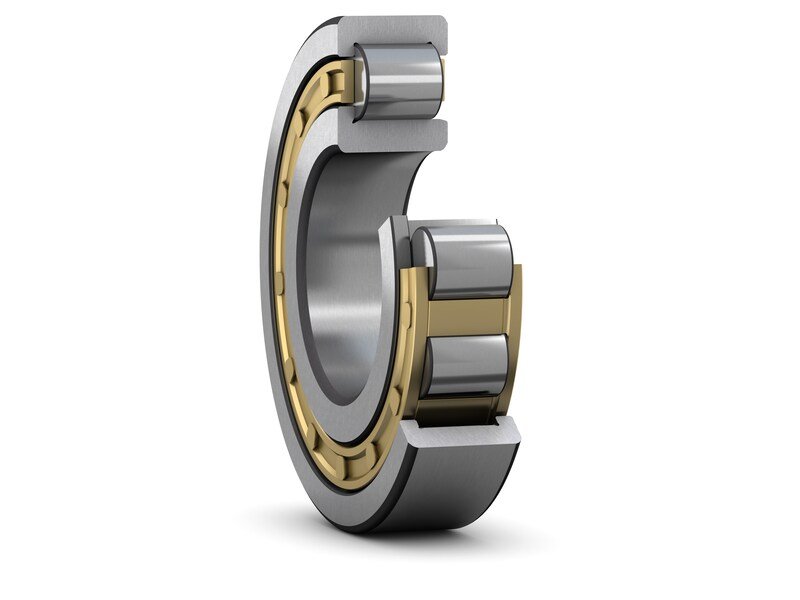
Cylindrical Roller Bearings – For Large Motors Subjected to Heavy Radial Loads
Large industrial motors can experience significantly high radial forces, particularly when driving equipment via belts or other heavily loaded configurations.
Cylindrical roller bearings offer higher load carrying capacity for radial forces because the rollers create a larger contact area with the raceway compared to balls.
They are frequently used in medium and large motors where a bearing must support substantial radial loads. Specific cylindrical roller bearing configurations can also accommodate axial movement caused by the thermal expansion of the motor shaft.
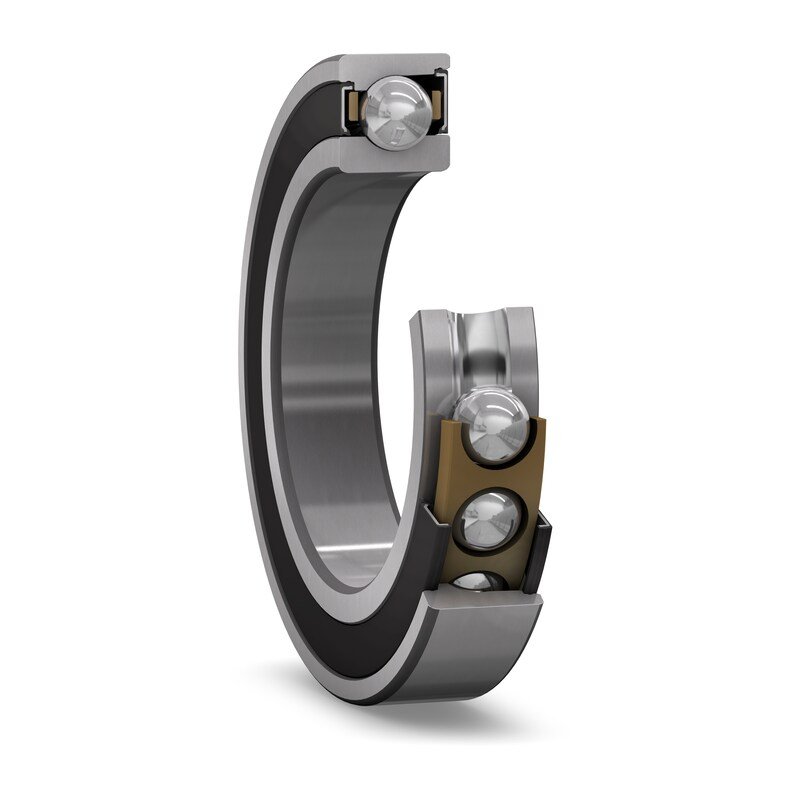
Angular Contact Ball Bearings – For Pump Motors Subjected to Axial Loads
Pump motor bearings often have to handle axial thrust in addition to radial forces. Angular contact ball bearings are suitable for such applications because their internal geometry is designed to accommodate combined loads.
They can be installed individually or in paired configurations, depending on the direction and magnitude of the axial force.
These bearings are particularly useful in vertical pump motors, high speed pumps, and other motor driven equipment where precise shaft positioning and axial support are critical.
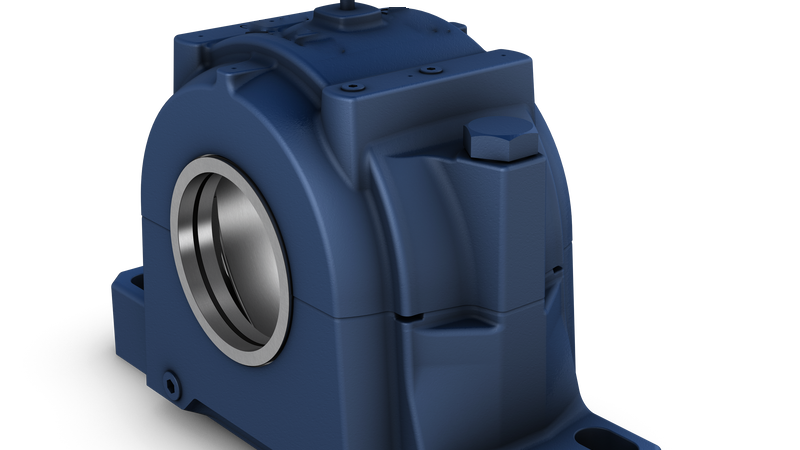
Spherical Roller Bearings – For Very Large Motors and Misalignment
Large motors used in heavy industrial equipment can experience shaft deflection, installation inaccuracies, or housing misalignment.
Spherical roller bearings can accommodate angular misalignment while supporting significant radial loads and axial forces. This makes them suitable for very large electric machines operating in heavy duty conditions.
They are a suitable choice for motors driving equipment such as crushers, mills, large conveyors, and other machinery where maintaining precise alignment during operation can be challenging.
Tapered Roller Bearings – For Motors Subjected to High Combined Loads
Tapered roller bearings are suitable for motor applications that generate significant radial and axial loads simultaneously. Their tapered geometry provides robust load carrying capacity, particularly when axial thrust is a critical operating factor.
They can be used in specialized motor configurations associated with heavy mechanical equipment, gear systems, and other applications involving demanding combined loads.
Proper adjustment is crucial, as clearance or preload can directly affect temperature, vibration, and bearing service life.
Hybrid Ceramic Bearings – For VFDs and High-Speed Motors
Modern inverters and VFD driven motors can experience electrical currents passing through conventional steel bearings. Over time, electrical discharge can damage the bearing raceways.
Hybrid ceramic bearings combine steel rings with ceramic rolling elements, providing electrical insulation between the shaft and the housing. Consequently, they are useful in applications where electrical damage to bearings is a concern.
Their low rolling-element density and favorable friction characteristics make the hybrid design attractive for high-speed electric motors.
Precision Ball Bearings – For Servo Motors
Servo motor bearings support applications where precise positioning, low vibration, low noise, and consistent rotational performance are critical.
High-precision deep groove or angular contact ball bearings are typically selected based on the servo motor design and load conditions.
Servo applications may require carefully controlled internal clearance or preload, as even slight, unwanted shaft movement can affect positioning accuracy. Robotics, CNC systems, automation equipment, and motion control systems are typical examples where bearing precision is particularly important.
Low-Friction Ball Bearings for HVAC Motors
HVAC motor bearings typically operate in fans, blowers, air-handling units, and ventilation systems, where quiet operation, efficiency, and long service intervals are desirable.
Deep groove ball bearings are generally suitable for these applications, as they can efficiently handle the typical radial loads found in fan systems while also operating at relatively high speeds.
Sealed and ‘lubricated for life’ designs can also reduce maintenance requirements for smaller HVAC motors.
Key Factors in Electric Motor Bearing Selection
Engineers should begin the bearing selection process by determining whether the motor will be subjected to radial, axial, or combined loads. Subsequently, the actual load magnitude should be compared against the bearing’s dynamic and static load ratings.
Operating speed is equally critical, as excessive speed can lead to increased friction and higher operating temperatures. Engineers must also evaluate factors such as lubrication, expected operating temperatures, shaft and housing fits, potential contamination, vibration, misalignment, and the required service life.
The bearing arrangement must also accommodate thermal expansion where necessary. For VFD driven motors, the risk of damage from electrical currents must be considered when deciding whether an insulated or hybrid bearing is required.
Conclusion
There is no single bearing that suits every electric motor. Deep groove ball bearings perform effectively in many standard AC, DC, and HVAC motors, whereas cylindrical roller bearings are better suited for heavy radial loads. Angular contact bearings provide additional axial support for pumps and vertical motor applications, while spherical roller bearings are useful in large machines where heavy loading and misalignment are concerns.
For VFD driven and electrically sensitive applications, hybrid ceramic bearings can offer added protection, while precision bearing configurations support the accuracy required by servo motors.
Reliable motor bearing design is achieved by matching bearing characteristics to the motor’s actual speed, load, environment, lubrication, and operating conditions, rather than simply selecting a bearing based on size.
FAQs
Deep groove ball bearings are commonly used in electric motors because they offer low friction, support radial and moderate axial loads, and perform well at high rotational speeds. They are widely used in AC and DC motors, fans, pumps, blowers, conveyors, and HVAC equipment.
Select an electric motor bearing based on factors such as radial and axial loads, operating speed, temperature, lubrication, shaft and housing fit, vibration, contamination, alignment, and required service life. The bearing’s dynamic and static load ratings should also match the motor’s actual operating conditions.
Deep groove ball bearings, precision ball bearings, and hybrid ceramic bearings can be suitable for high speed electric motors, depending on the application. Hybrid ceramic bearings are particularly useful where high speed and electrical insulation are critical, including certain VFD driven motor applications.
Deep groove ball bearings and angular contact ball bearings are commonly used in pump motors. Angular contact ball bearings are particularly suitable when the motor needs to handle both radial loads and significant axial thrust, such as in vertical pump and high speed pump applications.
Hybrid ceramic bearings are used in VFD driven motors to reduce the risk of electric current passing through the bearing. Their ceramic rolling elements provide electrical insulation, which helps protect the bearing raceways from electrical discharge damage while also offering advantages for certain high speed applications.